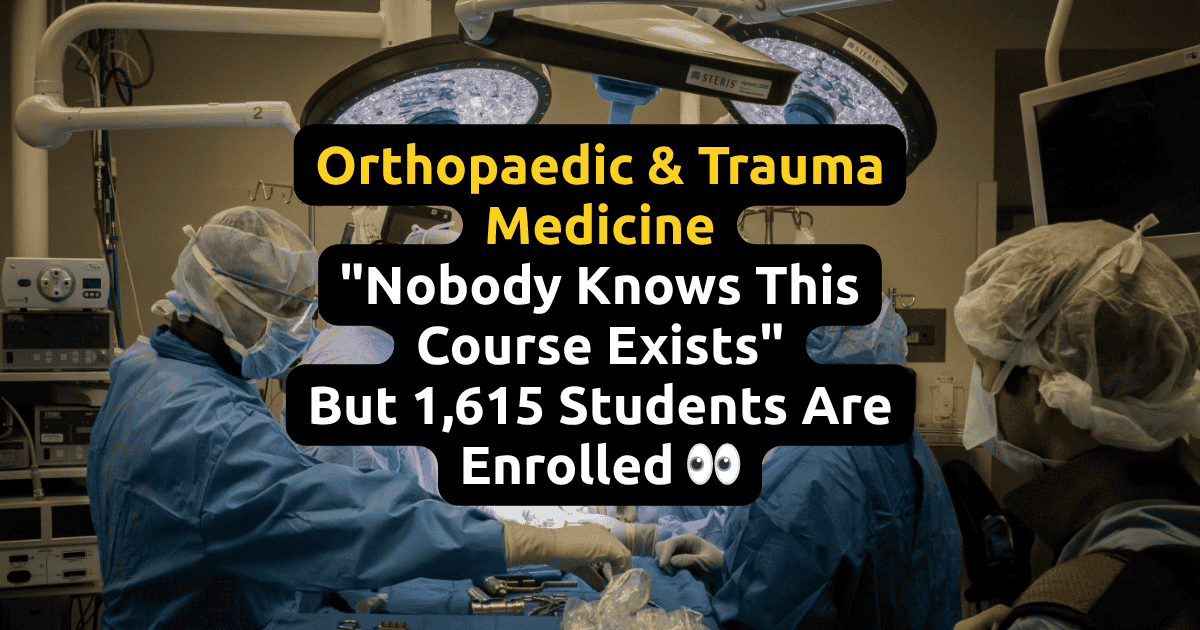
1,615 students enrolled. Highest certificate enrollment at KMTC.
Yet when you Google "KMTC courses," nobody mentions Orthopaedic & Trauma Medicine.
Let me show you what you're missing.
What Is Orthopaedic & Trauma Medicine?
You're the specialist who handles broken bones, fractures, dislocations, and trauma injuries.
When someone has a car accident and breaks their arm—you're the one who sets it, applies the cast, and manages their recovery.
Simple definition: The fracture and injury expert.
What You Actually Do
Your daily work includes:
- Manipulating and reducing fractures (putting broken bones back in place)
- Applying casts, splints, and bandages
- Fixing dislocations (popping joints back)
- Managing traction (devices that pull bones into place)
- Removing casts after healing
- Counseling trauma patients on recovery
- Working in emergency wards during accidents
You're hands-on. You're not diagnosing—you're FIXING.
The Salary Reality
Entry-level (0-2 years): KSh 30,000 - 40,000/month
Experienced (5+ years): KSh 50,000 - 60,000/month
Government scale (Job Group J): KSh 24,662 - 29,918
Contract positions: KSh 50,000/month
Reality check: Private hospitals pay better than government.
It's not the highest-paying medical course, but it's stable and in-demand.
Entry Requirements (EASIEST at KMTC)
Certificate in Orthopaedic & Trauma Medicine:
- KCSE Mean Grade: C- (minus)
- English OR Kiswahili: C-
- Biology or Biological Sciences: C-
- D+ in ONE of: Mathematics, Physics, Chemistry, Woodwork, Metalwork, Technical Drawing, Home Science, Agriculture, or Computer Studies
Duration: 2 years
This is the EASIEST medical course at KMTC. C- students who can't qualify for nursing, clinical medicine, or pharmacy—this is your entry point.
Where It's Offered
Available at KMTC campuses in: Machakos, Makindu, Chuka, Segowet, and Thika
(Note: This may have expanded—check KMTC website for current campuses)
The Job Market
Good news: High demand due to increasing prevalence of orthopaedic conditions and traumatic injuries.
Kenya's roads = daily accidents. Sports injuries. Falls. Construction accidents.
You will ALWAYS have work.
Where you'll work:
- Casualty/Emergency departments
- Orthopaedic wards
- Trauma centers
- County hospitals
- Private clinics
Why This Course is Underrated
1. Low competition Everyone's fighting for nursing and clinical medicine. Orthopaedic & Trauma? Less crowded.
2. Specific skill You're a specialist. Hospitals NEED you for fracture management.
3. Fast training 2 years certificate vs 3 years diploma for other courses.
4. Accessible entry C- students have a chance at a REAL medical career.
The Work Environment
Typical day:
8:00 AM - Check patients in orthopaedic ward
9:00 AM - Apply cast to fracture patient
11:00 AM - Remove cast from healed patient
1:00 PM - Emergency: Reduce dislocated shoulder
3:00 PM - Apply traction for femur fracture
5:00 PM - Counsel patient on recovery process
Reality:
- Hospital-based (not fieldwork)
- High patient volume (lots of accidents)
- Hands-on work (physical)
- Emotionally challenging (trauma cases)
The Downsides (Let's Be Honest)
❌ Repetitive work - You'll apply 20 casts a week, same procedure
❌ Emotionally heavy - Trauma victims, serious injuries, pain
❌ Lower salary - Certificate pays less than diploma courses
❌ Physical demands - Lifting patients, applying heavy casts
❌ Limited growth - Need diploma to advance
Career Progression
The smart path:
Year 1-2: Complete certificate
Year 3-5: Work, gain experience (earn while learning)
Year 6: Upgrade to Diploma in Orthopaedic Technology
Year 7+: Higher salary + senior positions
Many students use the certificate as a stepping stone to the diploma.
Should You Choose This Course?
✅ Yes, if you:
- Got C- in KCSE (can't qualify for other medical courses)
- Want hands-on medical work
- Can handle trauma and injury cases
- Need fast training (2 years)
- Want a specific, in-demand skill
- Don't mind physical work
❌ No, if you:
- Want high immediate salary
- Can't handle emotional trauma
- Prefer office/desk work
- Want variety (it's repetitive)
- Need patient interaction (you work quickly, move on)
The Bottom Line
Orthopaedic & Trauma Medicine is KMTC's most accessible medical course for C- students.
It's not glamorous. It's not high-paying initially. But it's:
- Accessible (lowest entry requirements)
- Needed (accidents happen daily)
- Specific (you have a marketable skill)
- Fast (2 years training)
- Upgradeable (pathway to diploma)
If you scored C- and thought "I can't do medicine"—you were wrong.
This is your entry point.